
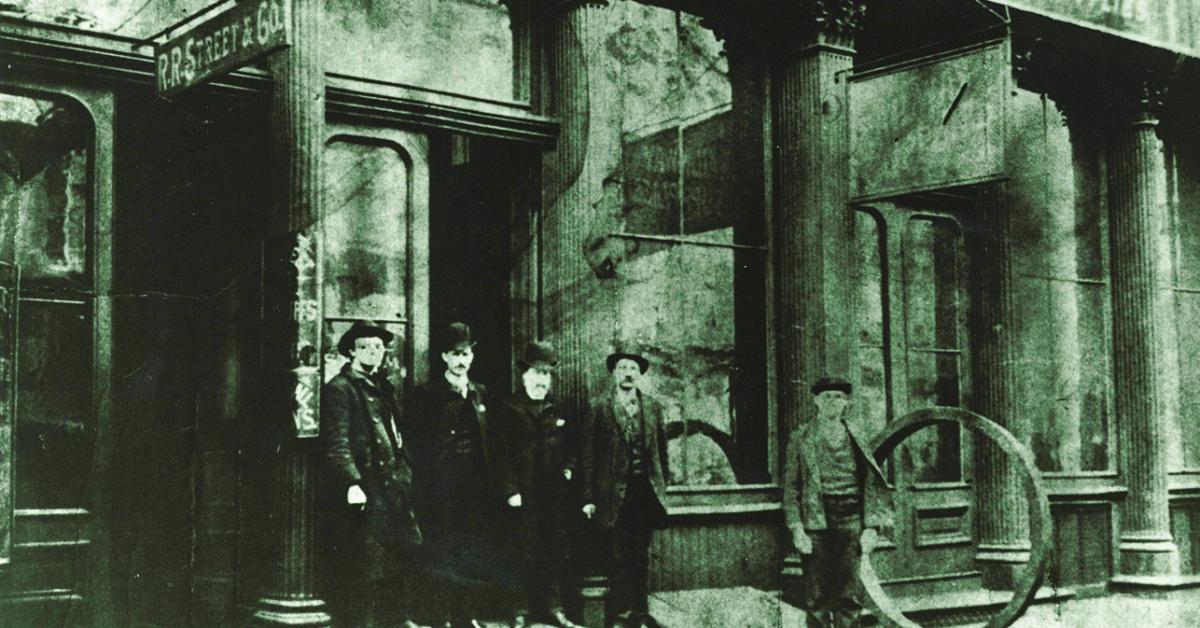
CHICAGO — In 1876, the United States was celebrating its centennial, Ulysses S. Grant was finishing his second term as president and Alexander Graham Bell had just invented the telephone. In Chicago, a city still rebuilding from the Great Fire of 1871, a Scottish immigrant named Robert R. Street saw three opportunities and decided to act on them.
“One opportunity was the boom of textile manufacturing along the Great Lakes and Mississippi,” says Jamie Mayberry, vice president of business development at R.R. Street & Co. “Two, you have the growth of Chicago as a central rail hub and general transportation hub in the Midwest. And then three, the Great Chicago Fire was only five years earlier, so you had a desire on the city’s part to rebuild and (offer) incentives to do so.”
Street’s launched as a catalog business, selling everything a textile factory might need — from I-beams and pulleys to needles and spools — and quickly built a national distribution footprint. It was not the drycleaning business yet. That pivot was still a generation away.
Kristen Vos, Street’s executive vice president, Americas, says the founding story still resonates within the company.
“Immigrants shaped our nation,” she says, “and to trace our roots back to that kind of determination, hard work, entrepreneurship — it just gives us great pride. And that has been passed on through generations of ownership.”
The Pivot
The decision that would shape the history of R.R. Street & Co. came in the late 1800s and early 1900s. The company added an R&D department and began developing improved dyes for linen manufacturing and the industry then known as professional cleaning and dyeing. The textile mill business that had launched Street’s was fading; professional dry cleaning was growing.
Mayberry says Robert Street’s flexibility to let go of one business model and embrace another is a lesson the company still draws on today.
“We have his willingness to completely shift his business model from the mill business to the then new professional dyeing and scouring — dry cleaning — business,” he says. “As he started to see the things changing in terms of how the business was going, he saw that there might be something to the professional cleaning thing.”
By the 1920s and ’30s, Street’s had developed the first filter for dry cleaning and was distributing drycleaning products nationally through appointed distributors. The industry was growing. Street’s was growing with it.
Built to Last
Getting from 1876 to 2026 required surviving more than a few hard stretches. These challenges included two World Wars; the Great Depression; wartime supply shortages that forced product innovation just to keep cleaners running; shifting solvent regulations; and pandemics.
The company keeps archives going back to its earliest decades, and Mayberry says reading through them offers a kind of perspective unavailable anywhere else.
“We have notes about just how challenging the Great Depression really was, about people’s personal losses, of loved ones during World War 2,” he says. “Just reading all this leads you to see how these large changes can happen really quickly. It’s moving, but it’s also very helpful.”
Those archives became directly relevant in 2020, when the coronavirus pandemic hit and the industry absorbed severe losses.
“Seeing these voices from the past, talking about just how hard it was, gives you perspective,” Mayberry says. “But also, it’s like a hand on your shoulder, giving you a little motivation to say, ‘Come on, you can do this. We toughed it through even worse. You can do it.’”
“Our DNA has always been rooted in resiliency and adaptability, but also relationships,” Vos says. “We’ve survived and grown through World Wars, economic crises, changing technologies and major shifts in the drycleaning and laundry industry. And we’ve been able to adapt because we’ve never stood still.”
The constants, she believes, have been just as important as the changes.
“We never lose sight of who we are. Street’s was built on trust and service, taking care of our customers and distributor partners. And those values have remained constant across the generations, even as the products, equipment and market dynamics have evolved pretty dramatically.”
Come back Thursday, when we’ll conclude our series by examining how education has become an investment for the company, and what its leaders see coming next for Street’s.
Have a question or comment? E-mail our editor Dave Davis at [email protected].